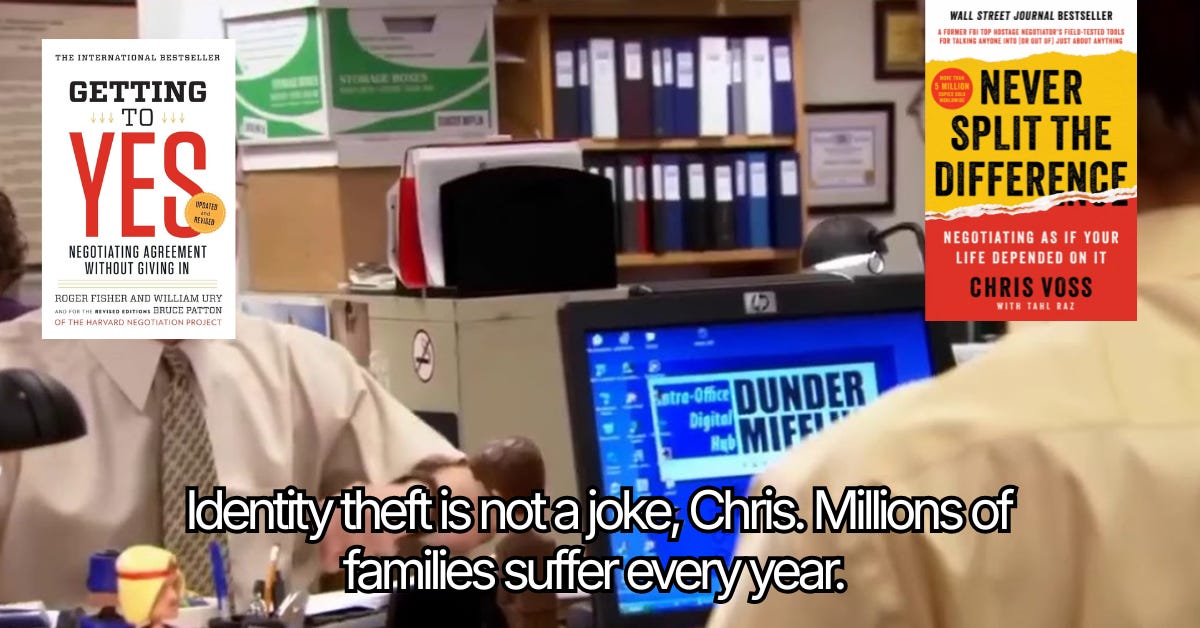

This post is actually based on a paper I wrote in law school.
While writing another Substack article, I mentioned Never Split the Difference and wanted to cross-reference a claim, so I pulled up the paper. Even as the author, I was truly engrossed in reading it. Not because I’m a great author, but the guy who wrote Never Split the Difference, Chriss Voss, is such a bullshitter. And such a bullshitter to the degree where you can use his own work and words against him. Yet somehow, he has amassed a large following.
Getting to Yes I had read twice; once in my Paralegal program in college, and again for an alternative dispute resolution (ADR) course in law school. I had attempted Never Split the Difference years ago but found the writing to be insufferable. I read it in full when I took the ADR course, thinking I would compare two different negotiation styles. But in reading Never Split the Difference, it quickly became apparent that it offered the exact same methods as Getting to Yes. The only difference was that it had extra pages dedicated to attacking Getting to Yes. Other than that, the methods are nearly identical. So why does one get dismissed while the other has a cult following?
The Books, Briefly
Getting to Yes was published in 1981 by Harvard professors Roger Fisher and William Ury. If you’re at all in the North American ADR space, then you know that this is like our Madonna and Michael Jackson. They more or less invented modern negotiation theory. Their approach, called “principled negotiation”, can be distilled down to four elements:
separate the person from the problem
focus on interests rather than positions
generate a variety of options, and;
anchor decisions to objective criteria.
They also introduced BATNA (Best Alternative to a Negotiated Agreement), which is widely used in business school curricula and in mediation work.
Fisher and Ury weren’t armchair theorists either; they practiced what they preached. Fisher advised the Ecuador-Peru border dispute, was involved in the Iranian hostage negotiations, assisted with the Camp David Accords, and helped guide South Africa’s post-apartheid constitutional process. Ury helped establish the Nuclear Risk Reduction Centres that led to Reagan and Gorbachev signing the first US-Soviet arms control agreement. There is a reason Getting to Yes has sold 15 million copies.
Never Split the Difference was published in 2016 by Chris Voss, a former FBI hostage negotiator. His strategy centres on emotional attunement: mirror what people say back to them, label their feelings, ask open-ended questions, use silence strategically, and demonstrate “tactical empathy.” The book sold 1 million copies and has an intensely loyal following, particularly among “alpha male” type business professionals.
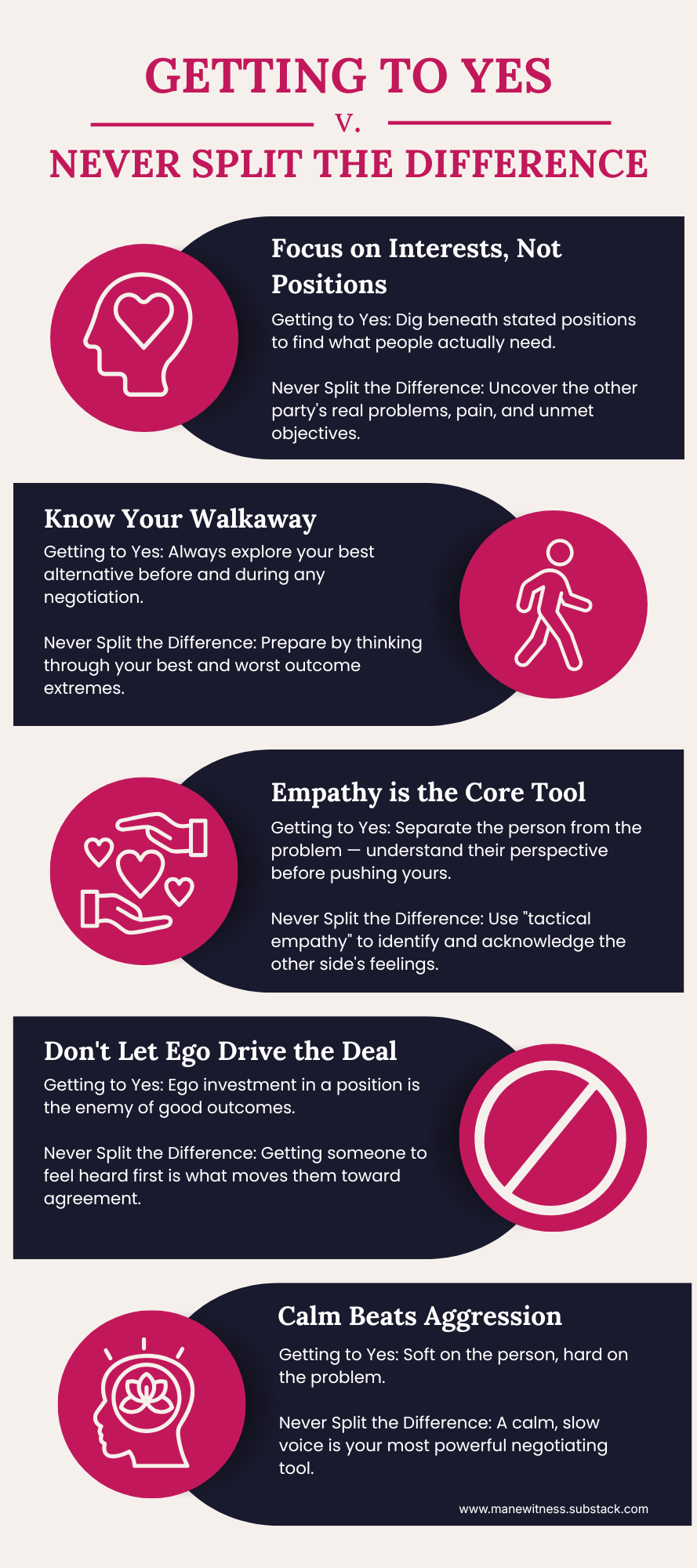
They Say the Same Things
When you lay the two methods side by side, the similarities are, I would argue, fundamentally the fucking same.
Discover interests
Getting to Yes: “As more attention is paid to positions, less attention is devoted to meeting the underlying concerns of the parties. Agreement becomes less likely. Any agreement reached may reflect a mechanical splitting of the difference between final positions rather than a solution carefully crafted to meet the legitimate interests of the parties.”
Never Split the Difference: “The presence of hidden interests isn’t as rare as you might think. Your counterpart will often reject offers for reasons that have nothing to do with their merits.”
Never Split the Difference: “If you can get the other party to reveal their problems, pain, and unmet objectives—if you can get at what people are really buying—then you can sell them a vision of their problem that leaves your proposal as the perfect solution.”
Objective criteria
Getting to Yes: “In short, the approach is to commit yourself to reaching a solution based on principal, not pressure. Concentrate on the merits of the problem, not the mettle of the parties. Be open to reason, but closed to threats.”
Never Split the Difference: “Fair?” you’d respond, pausing to let the word’s power do to them as it was intended to do to you. Follow that with a label: “It seems like you’re ready to provide the evidence that supports that,” which alludes to opening their books or otherwise handing over information that will either contradict their claim to fairness or give you more data to work with than you had previously.”
Variety of options
Getting to Yes: “The third point responds to the difficulty of designing optimal solutions while under pressure. Trying to decide in the presence of an adversary narrows your vision. … You can offset these constraints by setting aside a designated time within which to think up a wide range of possible solutions that advance shared interests and creatively reconcile differing interests.”
Never Split the Difference: “Deadlines regularly make people say and do impulsive things that are against their best interests, because we all have a natural tendency to rush as a deadline approaches.”
Never Split the Difference: “Understanding the “other” is a precondition to be able to speak persuasively and develop options that resonate for them.”
Never Split the Difference: “Great negotiators are able to question the assumptions that the rest of the involved players accept on faith or in arrogance, and thus remain more emotionally open to all possibilities, and more intellectually agile to a fluid situation.”
Best Alternative to a Negotiated Agreement (BATNA)
Getting to Yes: “Develop your BATNA. Vigorous exploration of what you will do if you do not reach an agreement can greatly strengthen your hand. Attractive alternatives are not just sitting there waiting for you; you usually have to develop them.”
Never Split the Difference: “I tell my clients that as part of their preparation they should think about the outcome extremes: best and worst. If you’ve got both ends covered, you’ll be ready for anything. So know what you cannot accept and have an idea about the best-case outcome”
When you get around Voss’ fluff and cut down to the core of what he says, he makes the exact same arguments that Getting to Yes is centred around.
And I bet Voss, to varying degrees, knows it’s the same stuff. Because why else would he dedicate so much page space to attacking Getting to Yes and principled negotiation? I think it's a tactic to misdirect the reader into thinking it’s a different book. Likely to save face from accusations of copyright and idea-stealing. And, of course, to build a brand where he monetizes off of both other people’s work and the insecurities of weak men.
What irks me is that Voss admits in his own book that the FBI trained its agents in principled negotiation. Voss himself even attended Harvard after retiring to study principled negotiation- the very same school the writers of Getting to Yes developed principled negotiations, I remind you. He is not hiding the fact that all his ideas in Never Split the Difference are built on the exact same information and principles as in Getting to Yes.
What irks me is that Voss admits in his own book that the FBI trained its agents in principled negotiation. Voss himself even attended Harvard, after retiring, to study principled negotiation- the very same school where the writers of Getting to Yes developed principled negotiations, I remind you. So, to recap, he learned about principled negotiation throughout his FBI career, then went to the school where it was founded to learn more, and now makes a career out of talking shit about it while also promoting it. And again, he says all this in his book. He is not hiding the fact that all his ideas in Never Split the Difference are built on the exact same information and principles as in Getting to Yes.
This makes his repeated criticism of Getting to Yes throughout the book rather awkward.
Voss is Not a Good Negotiator
Voss opens Never Split the Difference with a dramatic claim: everything we’ve been taught about negotiation is wrong, compromise is the worst thing you can do, and his field-tested FBI techniques will get you out of any scenario imaginable.
A few chapters later, he writes: “When individuals feel listened to, they tend to become less defensive and more willing to listen to other points of view, which gets them to the calm and logical place where they can be good Getting to Yes problem solvers.”
So: Getting to Yes doesn’t work. Unless the person has calmed down, at which point it works perfectly.
He also cites the Waco and Ruby Ridge standoffs as proof that Getting to Yes fails in high-stakes negotiations. But a closer look at both events complicates that narrative. In Waco, the FBI had successfully negotiated the release of 21 children before an unexpected gunshot derailed everything. In Ruby Ridge, agents couldn’t reach Randy Weaver because the cabin had no phone — they were literally yelling into a forest at a man who (unbeknownst to them) had already lost his wife. These aren’t failures of principled negotiation. They’re failures of logistics and circumstances that no negotiation framework could fully account for.
As for Voss’s two main hostage cases during his time as chief international negotiator, Jill Carroll and Steve Centanni (both American journalists kidnapped abroad), neither ended because of his negotiation “skills”. Carroll’s captors released her later with no explanation. Centanni was released after converting to Islam at gunpoint.
None of this is to say Voss is a fraud. But the dramatic line “our tools had to work, because if they didn’t, someone died” is a bit of an optimistic spin on a seemingly unsuccessful and complicated track record.
So What’s Actually Different?
If the methods are the same, what explains the wildly different reception?
Look at the packaging.
Never Split the Difference has a bold cover with ripped-page aesthetics and a subtitle, “Negotiate as if Your Life Depended on It”, that frames routine business negotiations as life-or-death situations. The writing throughout is urgent and dramatic. The examples involve kidnappers and terrorists. The whole thing is built to feel dangerous. But it’s written for people who work in sales or who want to be better at haggling over knick-knacks at yard sales.
Getting to Yes has a neutral cover. The examples include men and women negotiating ordinary disputes. The tone is clear and methodical without being theatrical. It presents negotiation as something anyone can and should do. It does not frame salary negotiations as a high-stakes arena for specialists - because it isn’t.
One book markets itself as combat. The other markets itself as a skill.
Back when I was reading these books to compare them, I realized the essay wasn’t workable because the two theories were too similar. But I was intrigued by the difference in presentation. And why Never Split the Difference repeatedly attacked the emotional intelligence that it also advocated for. It was clear that it was written for men, and I guess it felt that it had to lean into toxic masculinity tropes in order to get men to listen and try out being empathetic.
My research for the paper confirmed things I had already suspected. Studies into gender and negotiation find that men typically approach disputes more aggressively, making bold offers, asserting positions confidently, and taking risks. Women tend to use more collaborative, empathy-forward approaches, such as being attentive to others’ perspectives and focusing on relationship preservation and mutual outcomes. Getting to Yes reads like the second woman-approved approach. Never Split the Difference is marketed as the more male-centric way to negotiate, but make no mistake: it’s teaching you how to negotiate like a woman.
“Tactical empathy” is just empathy. Voss added the word “tactical” because empathy is too soft and mushy a concept for some people. But the practice he’s describing, which is genuinely trying to understand what the other person is feeling and reflecting it back to them, is exactly what Getting to Yes advocates. He’s dressed a traditionally feminine negotiation style in masculine clothing, and it worked brilliantly, I will admit. Because it gets rave reviews in the same posts that slam Getting to Yes.
Why Any of This Matters
There’s something worth sitting with here beyond the book drama.
Studies consistently find that men and women are treated differently at the negotiating table, even when they use identical tactics. Women who negotiate assertively face backlash for violating gender expectations. Men who negotiate collaboratively are sometimes seen as weak. The style that both of these books ultimately advocate for (being empathetic, interest-focused, relationship-preserving) is one that women have long been expected to practice, and men have often been discouraged from embracing.
What’s oddly hopeful about Never Split the Difference, despite all its contradictions, is that it gets men to practice that style by convincing them it’s something tougher than it actually is. Anyone who takes Voss’ advice will start genuinely listening to what the other side needs, acknowledging their concerns before they raise them, and resisting the urge to bulldoze toward a predetermined position. These are all things that will help someone negotiate better. It just took a former FBI guy and some fairytale spinning to get them there.
Gender performance is everywhere, but at the end of the day, we are all just trying to be women.